Research workspace

From inquiry to manuscript, without losing the thread.

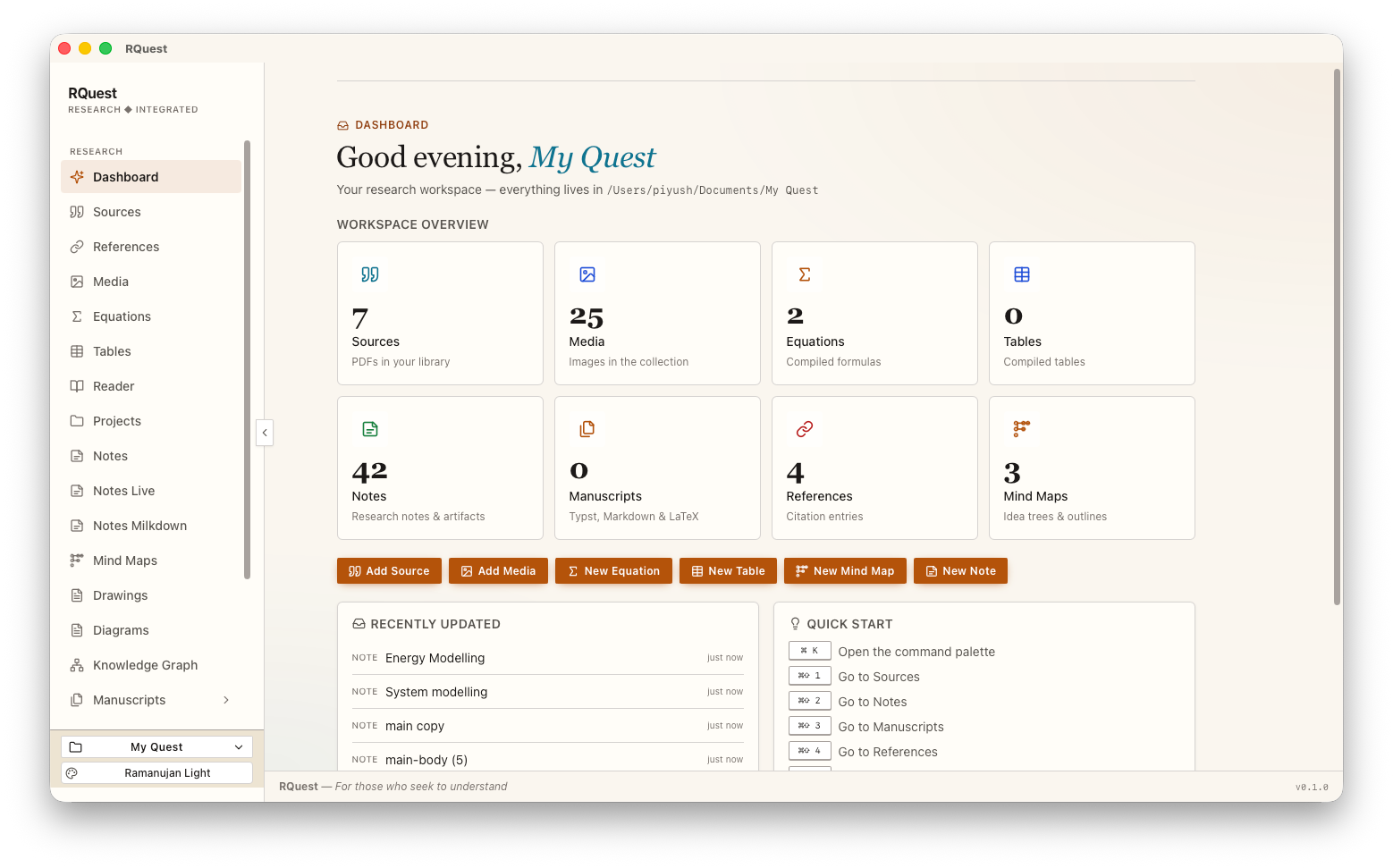
RQuest is a local‑first research workspace that carries your work through every stage — questions, sources, evidence, synthesis, claims, arguments, drafting, peer review, revision — as one connected, researcher‑owned vault. Not a document. A process.

local‑first — files over app — evidence before assertion
// evidence chain — claim to source, and back
Source [S‑01] Evidence [E‑04] Claim [C‑02] Argument [A‑01] Draft [M‑01] Reviewer challenge "insufficiently supported"
The problem

Your research is connected. Your tools aren't.

Reference manager, PDF reader, notes app, spreadsheet, word processor, submission portal, inbox. Every handoff between them is a place where the reasoning behind your work quietly falls out.

Without RQuest
  • Paper saved to a folder
  • Highlighted in a PDF reader
  • Re‑typed into a notes app
  • Tallied in a spreadsheet
  • Paraphrased into Word / LaTeX
  • Uploaded to a submission system
  • Critiqued in a reviewer PDF
  • Answered in a response letter, from memory
With RQuest
  • Source → connects to
  • Evidence, with the exact passage
  • Claim, with its supporting basis intact
  • Argument, built before the prose
  • Manuscript, written from the research
  • Reviewer comment, attached to the real object
  • Revision, traceable back to new evidence
  • One vault. Nothing re‑explained.
Architecture

Files over App.

"Your research has a life beyond RQuest."

The vault — plain files on your disk — is the source of truth. RQuest builds search indexes, embeddings, and a research graph on top of it, but those are derived, reconstructable representations. Delete the database and RQuest rebuilds it. Delete RQuest and your research remains.

  • Open the vault in any other application
  • Back it up with ordinary filesystem tools
  • Version it with Git
  • Sync it independently of RQuest
  • Write in Markdown, LaTeX, Typst, or DOCX
Research vault
source of truth
RQuest
Git
Other tools
↳ RQuest builds search, graph & AI retrieval on top — all derived, all rebuildable
The lifecycle

Eleven stages. One vault. No re‑entry.

This is the order research actually moves through — including backward, when a reviewer sends you back to stage four. Scroll to see the full arc.

[Q]

Question

State it, then let it evolve as the literature changes what's worth asking.

[S]

Sources

Gather papers, data, and archival material — interoperating with Zotero rather than replacing it.

[R]

Reading

Read with a purpose: a question, a method, a claim you're trying to test.

[E]

Evidence

A highlight becomes evidence once its relationship to a claim is understood.

[N]

Notes

What the source says, kept distinct from what you think about it.

[X]

Synthesis

Where sources agree, disagree, and where the evidence genuinely conflicts.

[C]

Concepts

Ideas that emerge from your synthesis, not from any single source.

[CL]

Claims

First‑class objects you can inspect: which ones rest on a single source?

[A]

Arguments

Claim → reason → evidence → counterargument, built before the prose.

[M]

Manuscript

Written from the research, in the file format you already use.

[V]

Review & revision

Reviewer comments attach to the object they challenge — and feed the next question.

Product

Built around what research actually is.

Six capabilities that fall out of treating research as a connected system, rather than a folder of files.

provenance

Evidence provenance

Every claim traces back to the exact passage it came from. Ask "what supports this?" and get an answer, not a citation you have to re‑verify yourself.

comparison

Literature matrix

A research‑native matrix of method, framework, findings, and limitations — a live view of your sources, not a spreadsheet that drifts out of date.

reasoning

Argument builder

Develop claim, reason, evidence, and counterargument before you write a single paragraph of prose that has to sound convincing.

review

Peer review loop

Reviewer comments attach to the claim or argument they challenge, with your decision — accept, clarify, disagree, defer — recorded alongside it.

memory

Research memory

Ten years on, ask why you chose a methodology or rejected an interpretation — and get the actual answer, preserved in the vault.

ai · optional

Grounded AI

AI operates over material you select and shows its work. No AI, local AI, or your own key — RQuest stays useful with AI turned off entirely.

AI philosophy

"Write this paragraph."
"Is this paragraph justified by the evidence?"

AI should help the researcher think, not replace the researcher thinking. It compares, questions, and surfaces contradictions — grounded in material you chose, never fabricating a connection you didn't ask it to find.

no AI local AI personal API key hosted AI institutional AI
Positioning

Not another tool for one artefact.

Each of these describes a real capability inside RQuest. None of them describes the product.

notan AI writing app for academics
nota better Zotero
notObsidian for researchers
notGoogle Docs for academics
isa research workspace built around the way research actually develops.
Philosophy

Eleven principles, held all at once.

Researcher first

The software serves the researcher.

Files over app

The application should never own the research.

Evidence before assertion

Claims connect to their supporting basis.

Context matters

A source without context is not enough.

Relationships matter

Meaning comes from connections, not accumulation.

Judgement matters

The researcher stays responsible for interpretation.

AI assists

It questions, compares, and supports — it doesn't decide.

Research is iterative

Going backwards is normal, not a failure.

Review is research

Criticism feeds back into the research structure.

The paper is an output

The project is larger than the manuscript.

Long‑term continuity

Research should stay understandable years later.

Ownership

You own the vault. RQuest owns the environment.

Early access

Where your research lives, evolves, and stays yours.

RQuest is in early access for researchers, labs, and PhD supervisors. Bring one project — arrive with the vault it deserves.

no spam — a handful of emails as we open access